Task A
In this task we were instructed to create a mind map to define what is teaching and learning from our experience. So, here are our mind map.
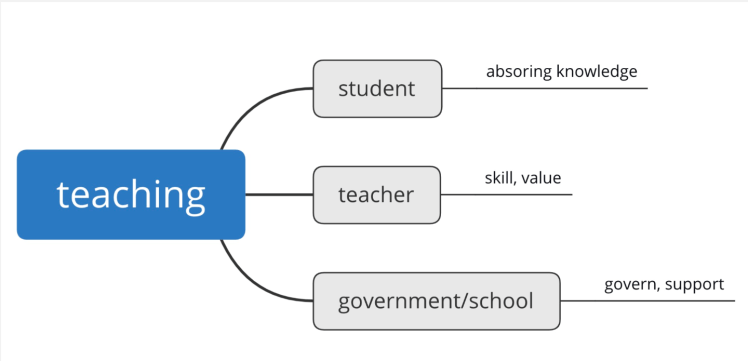

These mind maps were based on our experience in learning and teaching. In traditional teaching mode in China, teaching can be divided into three levels, students, teachers, and schools. They are all very significant and work together. For students, they are able to learn knowledge from teachers and their peers. The teacher plays the role of imparting knowledge, those who are very experienced. Governments and schools should give teachers great support in teaching equipment, funding, and so on.
For learning, we list some keywords in the mind map. There are some reasons why people need to learn something new. Firstly, we think that those who are little-known and want to avoid making mistakes in their lives and studies have a strong willingness to learn. Then, learning is beneficial to their thinking abilities. Also, when people attach great importance to learn, they can expand their knowledge.
Activity
As for our activity, we designed a simple learning design plan of a lesson based on the RASE framework. Here is our learning design plan.
Topic of a Learning Unit:
Creating a documentary video for last year of high school students by utilizing drones, cameras and video editing tools.
Learning Outcomes:
By the end of the lesson, the students will be able:
To understand the operational principle of drones and cameras, and also define different video making methods. (Recall – Personal – Declarative)
To explain how to capture a video by using drones and cameras, how to create and edit a video using video maker tools(iMovie), know how to write a script for a movie. (Explain – Popular – Procedural)
To produce a documentary, propaganda and promotional video for the school achievement as it can be used for graduation ceremony and Vlog of their daily school life. (Apply – Concept – Critical)
Activity:
1. Face-to-face Lecture
At the end of this activity, students will be able to:
– learn how to make a video with different methods.
– understand what drones and cameras are for
At the end of this activity, learners will deliver:
– the basic operation principle of drones and cameras
Scenario: The teacher will have a face-to-face lecture with the students to explain how to make a video and what drones and cameras are for.
2. Form Groups and Conduct Group Discussion
At the end of this activity, students will be able to:
– have a deeper understanding of drones and cameras.
– have a deeper understanding about methods of making video.
– understand the roles of producer, script maker, cameraman, editor and actor
At the end of this activity, learners will deliver:
– collaboration and communication
Scenario: The teacher will ask the students to form a group of 5 (based on the role), assign each person to a role and conduct group discussion.
3. Show some video samples and criticize them.
At the end of this activity, students will be able to:
– know the examples of the video that will be created.
– have critical thinking which is a good video and a bad video.
At the end of this activity, learners will deliver:
– self judgement about videos
Scenario: The teacher will provide video samples in the Google Classroom then the students will have to review the samples from their own perspectives.
4. Make a 2 minutes video about their daily life in school
At the end of this activity, students will be able to:
– capture a video using cameras and drones
– edit a video using iMovie.
– write a script for a movie.
– create a documentary, propaganda and promotional video
– have a deeper understanding of their role.
– demonstrate their own video to the public.
– uploading their video into YouTube or other websites.
– promote their own video to the public.
– present the process of making the video.
At the end of this activity, learners will deliver:
– final group project video
– final project presentation in the class.
Scenario:
1. The teacher will give a final group project assignment in the Google Classroom to make a 2 minutes video about daily life in school. Then, each group will try to create the video from what they have learned.
2. The teacher will arrange the final project presentation date in the Google Classroom. While waiting for the presentation day, the students will be prompted to upload their video to YouTube and promote their own video to the public. The best video and the most popular video will be awarded something by the teacher.
Resources:
– Cameras
– Drones
– Smartphone
– Computer/Laptop
– iMovie (software for video editing tools compatible for Windows and Mac)
– Real-time teaching
– Lecturer reference materials
– Lecturer slides and notes
Support:
F&Q
1. How to operate a drone or a camera?
2. How to output the videos from drone and camera to iMovie for editing?
3. How long the appropriate time for a documentary?
4. Can they use video editing tools besides iMovie?
5. If a group consists of 4 people, how to assign the role of each person?
6. Is popular means that we have the most liked or the most viewed video?
7. How to evaluate a peer who is a free-rider?
8. How to install iMovie on Windows?
For students that have any further questions before or after class, the teacher will provide his/her email.
Forums
For students to share their videos or seek help from the teacher or their classmates.
Evaluation
Peer assessment
Students will assess their classmates’ videos on Google Classroom.
Peer review
Students will review their peer groups contribution using Google Classroom.
Self-review
Students portfolios will be reviewed using Google Classroom for each topic they have learned.
| Category | 4 | 3 | 2 | 1 | Score |
| Teamwork | Students meet and discuss regularly. All students contribute to the discussion and all are listened to respectfully. All team members contribute a fair share of the work. | Students meet and discuss regularly. Most students contribute to the discussion and are listened to respectfully. All team members contribute a fair share of the work. | A couple of team meetings are held. Most students contribute to the discussion and are listened to respectfully. All team members contribute a fair share of the work. | Meetings are not held AND/OR some team members do not contribute a fair share of the work. | |
| Concept | Team has a clear picture of what they are trying to achieve. Each member can describe what they are trying to do and generally how his/her work will contribute to the final product. | Team has a fairly clear picture of what they are trying to achieve. Each member can describe what they are trying to do overall but has trouble describing how his/her work will contribute to the final product. | Team has brainstormed their concept, but no clear focus has emerged for the team. Team members may describe the goals/final product differently. | Team has spent little effort on brainstorming and refining a concept. Team members are unclear on the goals and how their contributions will help them reach the goal. | |
| Script | Script is complete and it is clear what each actor will say and do. Entries and exits are scripted as are important movements. Script is quite professional. | Script is mostly complete. It is clear what each actor will say and do. Script is shows planning. | Script has a few major flaws. It is not always clear what the actors are to say and do. Script shows an attempt at planning, but seems incomplete. | There is no script. Actors are expected to invent what they say and do as they go along. | |
| Storyboard | Storyboard is complete with sketches for each scene, detailed notes on titles, transitions, special effects, sound, etc. Storyboard reflects outstanding planning and organization for the visuals in the video. | Storyboard is relatively complete with sketches for most scenes, and notes on titles, transitions, special effects, sound, etc. Storyboard reflects effective planning and organization for the visuals in the video. | Storyboard has glaring omissions in scene planning. There are some sketches, and notes on titles, transitions, special effects, sound, etc. Storyboard reflects attempts at planning and organization for the visuals in the video. | Storyboard is not done or is so incomplete that it could not be used even as a general guide. Storyboard reflects very little planning of the visuals. | |
| Equipment Preparation | All necessary equipment/supplies are located and scheduled well in advance. All equipment (sound, light, video) is checked the day before the shoot to ensure it is operational. A backup plan is developed to cover possible problems with power, light, etc. | All necessary equipment/supplies are located and scheduled a few days in advance. All equipment (sound, light, video) are checked the day before the shoot to ensure they are operational. A backup plan is developed. | On the day of the shoot, all necessary equipment/supplies are located and checked to ensure they are operational. There may or may not be a backup plan. | Needed supplies/equipment are missing OR were not checked before the shoot. | |
| Sound Setup | Microphones are positioned optimally to ensure that important sounds and dialogue are captured. The team has made every attempt to anticipate and filter out unwanted ambient noise in the recording. | Microphones are positioned optimally to ensure that important sounds and dialogue are captured. | At least one microphone (in addition to that on the camera) is used to ensure that dialogue is captured. | Little attention was paid to ensuring quality sound during the shoot. | |
| Lighting Setup | Additional lighting has been used to eliminate shadows and glares. Cameras are set to the appropriate light level. | Additional lighting has been used, but may not be set up optimally. Cameras are set to the appropriate light level. | Cameras are set to appropriate light level, but no additional lighting was used when needed. | Cameras Drone are not set to appropriate light level. Additional lighting may, or may not, be used. |
My Learning design is available for viewing at:
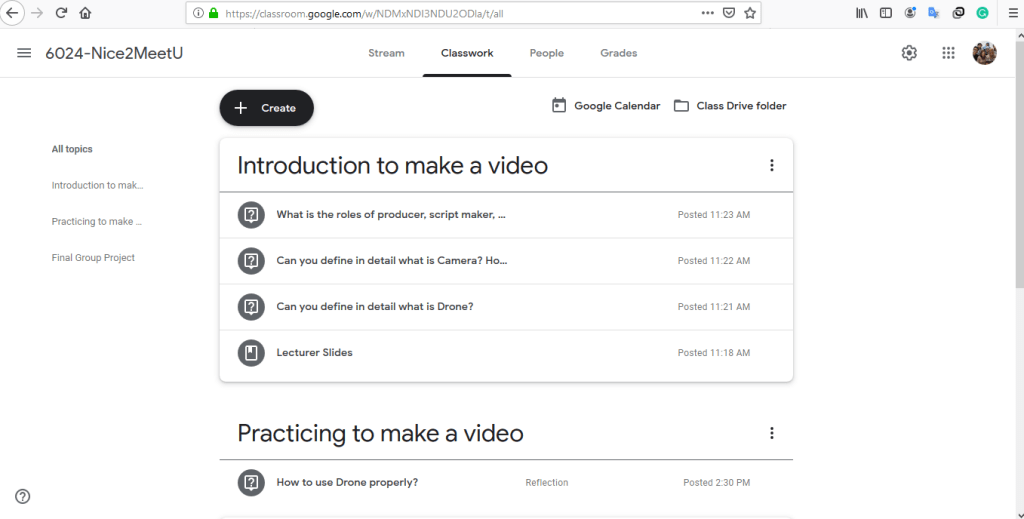
Google classroom, access the classroom.google.com and input the class code: e9aenar. Here is our screenshots of our Google Classroom.

Theoretical Perspective:
Contemporary learning outcomes are based on the theory of knowledge dimension model. We could see how they occur within these steps. According to the category of content knowledge, teachers give a definition of relevant principles, which can also be regarded as a review of what they already know about the knowledge of audio-video making. Then the students can have a deep understanding of the knowledge construction during the process of teaching activities. Finally, students can transform what they have learned into something that can be applied or even create an innovation. Thus, in this way, the teachers will act as a facilitator.
We design the activity based on the RASE model. The RASE model is the student-centered learning design model, it contains four components: Resources, Activity, Support, and Evaluation. The four elements need to be well designed for full achievement of learning outcomes. The RASE model is significant because it can assist teachers on how to design better courses and promote the use of information technology in education to educate digital learners.
There might be four key factors that make learning occur. First, facilitators should examine the learners’ expectations at the very beginning of the course. They should also cover various teaching methods and activities to maintain the learners’ motivations and interests. Second, learners should be encouraged to reflect on what they have learned by using a reasonable assessment and feedback system. Third, facilitators may need to provide the learners with enough support, such as learning resources, reactions, and answers to their questions. Finally, the education reform purpose is to allow the learners to become life-long learners. In other words, the learners have life-long study awareness and abilities.
 Nice2MeetU Group's E-Portfolio